
Consumer unit upgradesin Cwmbran and South Wales,tested and certified
Replace an old fuse box with modern protection that switches off a fault in a fraction of a second. One visit, minimal disruption, full certification and a 12-month workmanship guarantee.
NAPIT Approved · Part P registered · £2m public liability
Over 15 years
In the industry
NAPIT Approved Contractor
Reg. no. 63450
Part P Registered
Via NAPIT scheme
£2m Public Liability
Fully insured
12-Month Guarantee
On workmanship
Service overview
Consumer Unit Upgrades: what it is and when you need it
What a consumer unit does
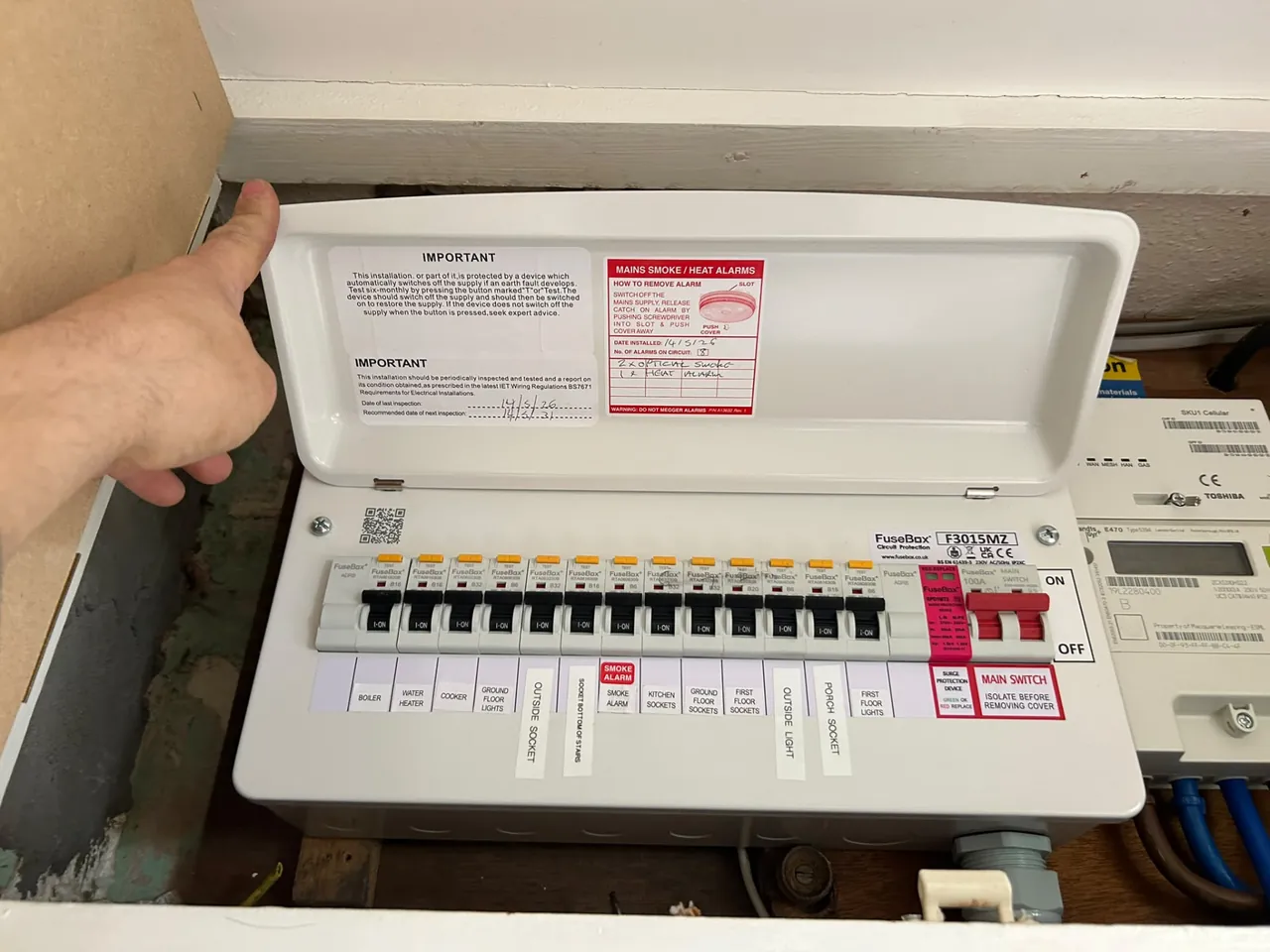
The consumer unit, often still called the fuse box, is where your home's electricity is split into separate circuits for lights, sockets, the cooker, the shower and so on. Each circuit has a protective device that switches it off if something goes wrong. Modern units use circuit breakers and residual current protection (RCDs or RCBOs), which detect earth leakage and disconnect the supply quickly to reduce the risk of electric shock and fire.
Who it is for
Homeowners with an older fuse box using rewireable fuses or early breakers, landlords who have received recommendations on an EICR, people adding an EV charger, heat pump or new kitchen, and anyone renovating who needs extra circuits. Small commercial premises benefit in the same way.
When an upgrade is needed
Common triggers include a fuse box with wire fuses, no RCD protection, a plastic unit in an area where current regulations call for a non-combustible enclosure, frequent tripping, signs of overheating, or an EICR that codes the unit as needing improvement. Adding significant new loads is another reason.
Why professional installation matters
Replacing a consumer unit means working at the heart of your installation. Before the new unit goes in, each circuit must be tested so that existing faults are found rather than hidden. A NAPIT Approved, Part P registered electrician carries out the work, tests every circuit and issues the certification your home insurer and future buyers will expect.
What happens if it's ignored
The risks of putting it off
An outdated fuse box can carry on for years without a problem, right up until the day protection is needed and it doesn't react in time.
Slower or no shock protection
Without RCD protection, a fault that sends current through a person may not disconnect quickly enough. Modern protection is designed to react in milliseconds.
Fire risk from overheating
Loose connections, worn fuse carriers and overloaded circuits can overheat inside an old board, often out of sight.
Problems adding new circuits
An old or full board can hold up an EV charger, kitchen refit or extension, causing delays when you least want them.
Issues at sale or tenancy
Buyers' surveys and landlord inspections often flag old boards, which can delay a sale or a let.
Common mistakes to avoid
- Replacing a fuse with a thicker wire or higher rating to stop it blowing.
- Ignoring a board that trips regularly instead of finding the cause.
- Choosing the cheapest swap without proper testing of the existing circuits.
- Waiting until a sale or tenancy deadline to deal with it.
Our process
How the job is done, step by step
01
Free inspection
Thomas looks at your existing board, the circuits it serves and how your home is earthed.
02
Testing existing circuits
Circuits are tested before changeover so hidden faults are identified and explained.
03
Board replacement
The old unit is removed and the new one installed with the right protection for each circuit, neatly labelled.
04
Full testing and verification
Every circuit is tested on the new board before the power is restored for good.
05
Certification and guarantee
You receive certification and the work is backed by a 12-month workmanship guarantee.
Benefits
What you get when it's done properly
Faster protection
Modern RCD protection disconnects faults far more quickly than old rewireable fuses.
Fewer whole-house outages
Better separation of circuits means one fault doesn't have to take out the whole home.
Ready for new loads
Space and protection for an EV charger, new kitchen or extension.
Easy to reset
No more hunting for fuse wire: a tripped breaker is simply switched back on once the fault is cleared.
Clear labelling
Each circuit is labelled so you know what is what.
Paperwork in place
Certification for insurers, buyers, letting agents and your own records.
In detail
Consumer units explained: types, protection and situations
Rewireable fuses, MCBs, RCDs and RCBOs
Older boards use rewireable fuses: a thin wire that melts under overload. Miniature circuit breakers (MCBs) replaced these and switch off on overload or short circuit. RCDs add protection against earth leakage, typically covering a group of circuits. RCBOs combine both functions on a single circuit, so a fault on one circuit only switches that circuit off. The right combination depends on your home and budget, and Thomas will explain the options.
Metal enclosures
Current regulations require consumer units in domestic premises to have a non-combustible enclosure, which in practice usually means metal. This helps contain a fire should a connection overheat inside the board.
Surge protection
Surge protection devices help protect the installation and connected equipment from transient overvoltages. Whether one is needed is assessed as part of the design of your new board.
Faults found during an upgrade
Testing before changeover sometimes reveals faults on existing circuits that the old board was not sensitive enough to detect. These need resolving before the new protection can be relied upon. You'll be told what was found and what it means before anything further is done.
Domestic and commercial boards
In homes the job is normally a single-phase consumer unit. Commercial premises may have distribution boards, more circuits and different equipment loads, and work is planned around opening hours where possible to limit disruption.
Labelling and future additions
Every circuit on your new board is clearly labelled, so in future anyone working on the installation, or you, resetting a tripped circuit, knows exactly what each device controls. Where possible, spare ways are left so that new circuits, such as an EV charger or garden supply, can be added without changing the board again.
Why VE Electrical
Consumer Unit Upgrades from the electrician who does the work
VE Electrical Services is owner-led. When you book consumer unit upgrades with us, the person who quotes the job is Thomas Villars: the same fully qualified, NAPIT-registered electrician who carries it out, tests it and signs it off. There is no hand-off between a salesperson and a fitter, and no call centre between you and the answers you need.
Thomas has over 15 years' experience in the industry and set up the business eight years ago in Cwmbran. The business is a NAPIT Approved Contractor (registration no. 63450), Part P registered, carries £2 million public liability insurance and is a TrustATrader member. Every job is backed by a 12-month workmanship guarantee.
Quotes and site visits are always free. You get honest advice on what is needed, a clear price before work starts, and certification when the job is complete. For larger projects, trusted subcontractors are brought in, with Thomas remaining your single point of contact from start to finish.
FAQ
Consumer Unit Upgrades questions
How much does a consumer unit upgrade cost?
+
The price depends on the number of circuits, the type of protection chosen and what the testing finds. The quote and site visit are free, and you'll get a clear price before work starts.
How long will the power be off?
+
A typical domestic changeover is completed in a day, with the power off for part of it. You'll be told what to expect beforehand so you can plan around it.
Do I need an upgrade if my fuse box still works?
+
Not always, but an old board without RCD protection doesn't offer the level of protection modern ones do. Thomas will give you honest advice on whether an upgrade is worthwhile.
What if faults are found during testing?
+
You'll be told what was found, why it matters and what it would take to fix, before any further work is carried out.
Will I get a certificate?
+
Yes. All work is tested and certified, and you receive the paperwork once the job is complete.
Is the work guaranteed?
+
Yes. All work comes with a 12-month workmanship guarantee.
My board keeps tripping. Is that a reason to replace it?
+
Tripping usually means protection is doing its job and there's a fault somewhere. Fault finding is the first step; a new board may or may not be needed.
Do you cover Newport and Cardiff?
+
Yes. VE Electrical covers Cwmbran, Newport, Cardiff, Pontypool, Abergavenny, Monmouth, Pontypridd, Bristol and surrounding areas.
Related services
Areas covered
Consumer Unit Upgrades from our Cwmbran base across South Wales and Bristol.
Get modern protection for your home
Book a free inspection of your fuse box and get honest advice on whether it needs upgrading. Quotes and site visits are always free.
NAPIT Approved Contractor no. 63450 · £2m public liability · 12-month workmanship guarantee