
EV charger installationin Cwmbran, fitted safelyand certified properly
Wake up to a full battery every morning. Thomas checks your supply, fits your charger neatly and certifies the circuit, so you can charge at home without worrying about overloads or untidy cabling.
NAPIT Approved · Part P registered · 12-month workmanship guarantee
Over 15 years
In the industry
NAPIT Approved Contractor
Reg. no. 63450
Part P Registered
Via NAPIT scheme
£2m Public Liability
Fully insured
12-Month Guarantee
On workmanship
Service overview
EV Charger Installation: what it is and when you need it
What an EV charger installation involves
A home EV charger is a dedicated wall-mounted unit on its own circuit, wired back to your consumer unit with protection sized for the load. Fitting one properly is more than mounting a box on a wall: the existing supply has to be assessed, the cable run planned, the right protective devices selected and the earthing arrangement checked so the charger is safe in all conditions. The finished circuit is then tested and certified.
Who it is for
Homeowners with an electric or plug-in hybrid car, people planning to switch to an EV in the near future, and small businesses that want charging available for staff or company vehicles. If you have off-road parking, such as a driveway, garage or private space, a dedicated charger is usually the most convenient way to charge.
When you need one
Most people arrange an installation shortly before or after their new car arrives. It is also worth doing if you are currently charging from a standard three-pin socket with a granny cable, which is slow and puts a long, continuous load on a socket that was never designed for it.
Why a qualified electrician matters
An EV charger draws a heavy current for hours at a time. Undersized cable, missing protection or a poor earth can cause overheating, nuisance tripping or, at worst, a risk of electric shock. Using a NAPIT Approved, Part P registered electrician means the work is designed, tested and certified to current wiring regulations, and you receive the paperwork to prove it.
What happens if it's ignored
The risks of putting it off
Cutting corners on an EV charger rarely shows up on day one. It shows up months later, usually on a cold night when the car needs to be ready by morning.
Overloaded supply
Adding a large continuous load without checking the rest of the house can lead to the main fuse being stressed, lights dimming or circuits tripping when the oven, shower and charger run together.
Overheating sockets and leads
Relying on a three-pin socket and extension lead for daily charging can cause plugs and sockets to run hot. Scorched sockets are a common sign the setup is being pushed too hard.
Earthing problems outdoors
Chargers are often fitted outside, where earthing needs particular care. Getting it wrong can leave exposed metalwork at risk of becoming live under fault conditions.
Paying twice
A cheap, poorly planned install often has to be stripped out and redone, costing more than doing it right the first time.
Common mistakes to avoid
- Buying a charger before checking whether the home's supply and consumer unit can support it.
- Choosing the shortest cable route rather than the safest, neatest one.
- Using an extension reel for regular charging.
- Assuming any electrician can sign off the work without the correct registration and certification.
Our process
How the job is done, step by step
01
Free site visit
Thomas looks at where you park, where the consumer unit is and how the cable can be routed neatly.
02
Supply and load check
Your existing supply, main fuse and consumer unit are assessed to make sure they can take the extra load.
03
Installation
The charger is mounted, a dedicated circuit is installed and the correct protection is fitted at the consumer unit.
04
Testing and verification
The new circuit and earthing are tested to current regulations before the charger is switched on.
05
Handover and guarantee
You are shown how it works, given your certification, and the work is backed by a 12-month workmanship guarantee.
Benefits
What you get when it's done properly
Charge while you sleep
Plug in when you get home and leave with a full battery, without trips to public chargers.
Safer than a three-pin plug
A dedicated, protected circuit is designed for the long, heavy load that charging creates.
Built to last
Correctly sized cable and protection reduce wear and the chance of faults over the years.
Tidy finish
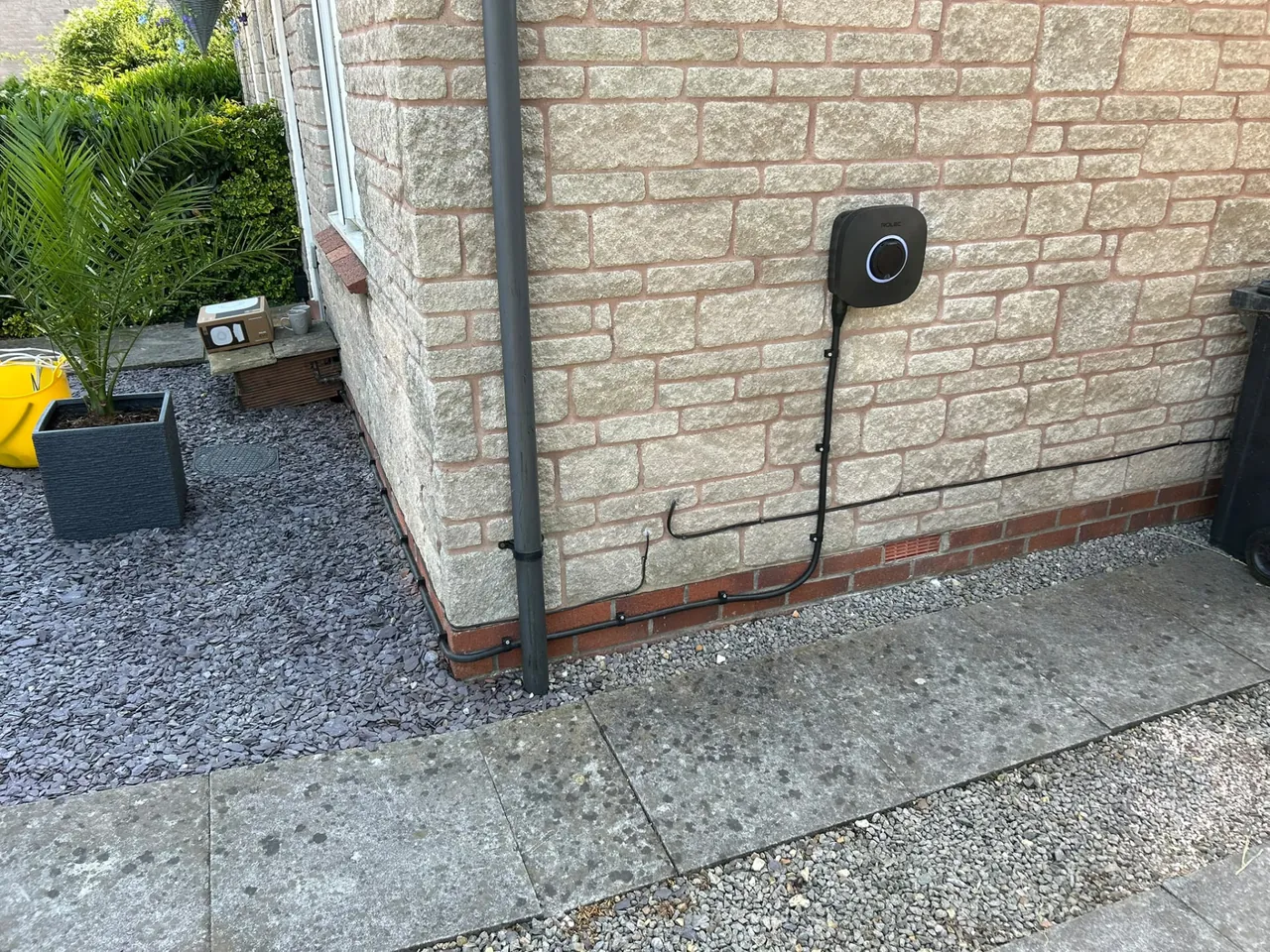
Cable runs are planned for a neat result on the outside of your home.
Certified work
You receive certification for the new circuit, useful for insurance and when selling your home.
One point of contact
You deal with Thomas from quote to handover, so nothing gets lost between people.
In detail
EV charging in detail: what affects your installation
Tethered and untethered chargers
A tethered charger has a cable permanently attached, so you simply unhook it and plug in. An untethered charger has a socket and you use your car's own cable. Tethered units are quicker to use day-to-day; untethered units look cleaner on the wall and suit households with different vehicles. Both are installed on a dedicated circuit in the same way.
Cable routes and mounting positions
The charger is normally mounted on an external wall close to where you park, or inside a garage. The cable is routed from the consumer unit by the safest practical path: through the wall, along clipped runs or through suitable containment. Longer runs need a larger cable to limit voltage drop, which is one reason a site visit matters before quoting.
Consumer unit and protection
A charger needs suitable overcurrent and residual current protection. Some older consumer units do not have the space or the right type of protection, in which case an upgrade may be recommended. You will be told about this at the quote stage, not halfway through the job.
Earthing arrangements
The way your property is earthed affects how an outdoor charger is protected. Some chargers include built-in protection that handles this; in other cases additional measures are needed. Thomas checks your arrangement and explains the option that suits your home.
Homes and businesses
For a house, the job is usually a single charger on a dedicated circuit. For commercial premises, multiple chargers may be needed, and the overall load on the building's supply has to be planned so chargers, lighting and equipment can run together. Larger commercial jobs can be supported by trusted subcontractors where needed.
Why VE Electrical
EV Charger Installation from the electrician who does the work
VE Electrical Services is owner-led. When you book ev charger installation with us, the person who quotes the job is Thomas Villars: the same fully qualified, NAPIT-registered electrician who carries it out, tests it and signs it off. There is no hand-off between a salesperson and a fitter, and no call centre between you and the answers you need.
Thomas has over 15 years' experience in the industry and set up the business eight years ago in Cwmbran. The business is a NAPIT Approved Contractor (registration no. 63450), Part P registered, carries £2 million public liability insurance and is a TrustATrader member. Every job is backed by a 12-month workmanship guarantee.
Quotes and site visits are always free. You get honest advice on what is needed, a clear price before work starts, and certification when the job is complete. For larger projects, trusted subcontractors are brought in, with Thomas remaining your single point of contact from start to finish.
FAQ
EV Charger Installation questions
How much does an EV charger installation cost?
+
Every home is different, so the price depends on the charger, the length of the cable run and whether any consumer unit work is needed. The quote and site visit are free, and you get a clear price before any work starts.
How long does an installation take?
+
A straightforward home installation is typically completed within a day. If a consumer unit upgrade is needed as well, you will be told how that affects the timeline at the quote stage.
Can my home take an EV charger?
+
Most homes can, but the supply, main fuse and consumer unit need checking first. That check is part of the free site visit.
Will I get certification?
+
Yes. The new circuit is tested and certified to current wiring regulations, and you receive the paperwork once the job is complete.
Is the installation guaranteed?
+
Yes. All work comes with a 12-month workmanship guarantee.
Can you fit a charger I've already bought?
+
Often, yes. Let Thomas know the make and model when you get in touch so it can be checked before the visit.
Do you install EV chargers outside Cwmbran?
+
Yes. VE Electrical covers Newport, Pontypool, Cardiff, Abergavenny, Monmouth, Pontypridd, Bristol and the surrounding areas.
Do you install chargers for businesses?
+
Yes. Commercial installations are quoted individually after a site visit to assess the building's supply and the number of charge points needed.
Related services
Areas covered
EV Charger Installation from our Cwmbran base across South Wales and Bristol.
Charge at home with confidence
Book a free site visit and get a clear, fixed quote for your EV charger. Quotes and site visits are always free.
NAPIT Approved Contractor no. 63450 · £2m public liability · 12-month workmanship guarantee